


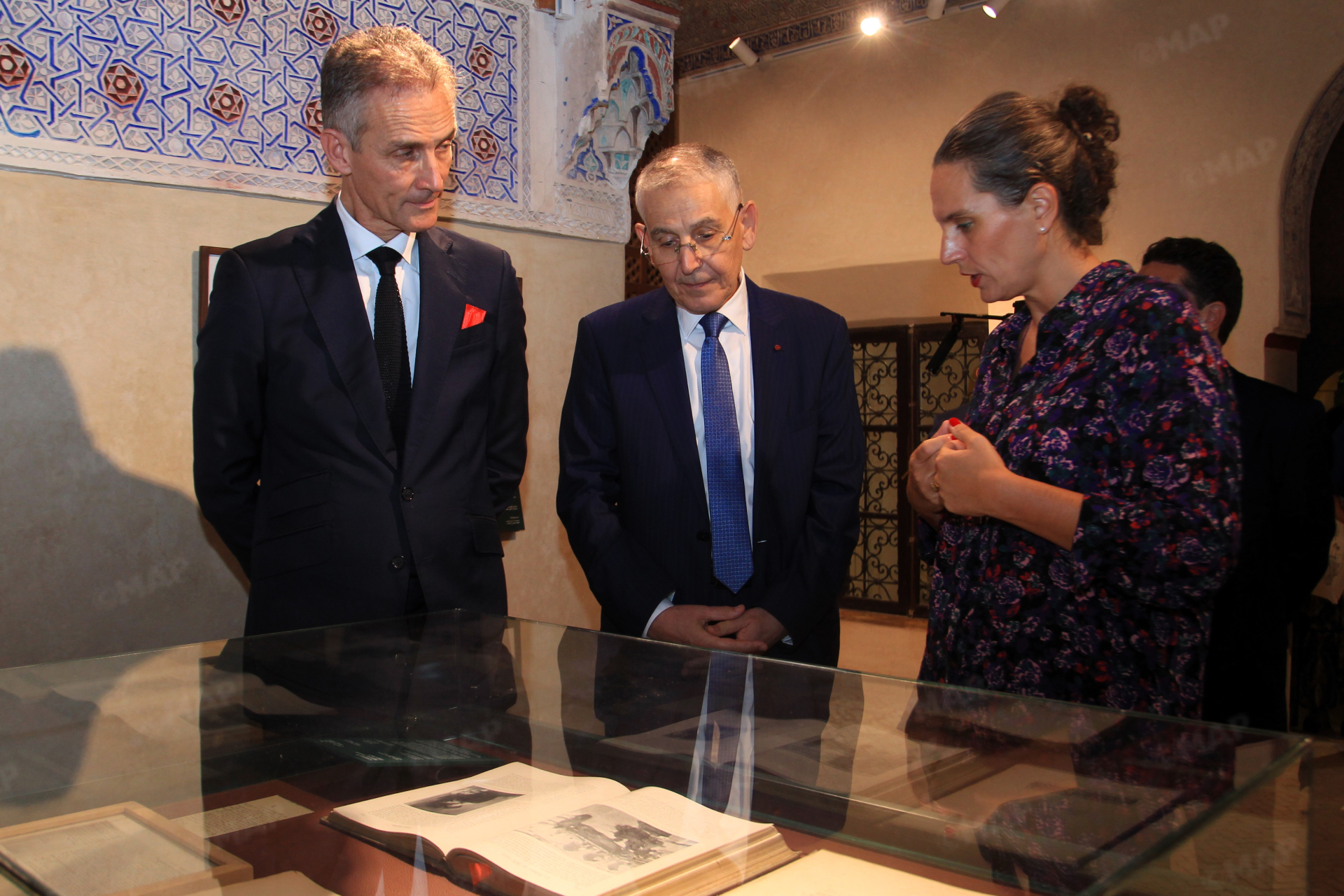
A new museum space dedicated to the life and intellectual legacy of the renowned French writer and scholar Denise Masson has officially opened in Marrakech. Managed by the French Institute of Marrakech, the inauguration ceremony was attended by the Wali of the Marrakech-Safi region and Governor of Marrakech Prefecture, Khatib El Hebil, alongside distinguished Moroccan and French figures from the worlds of culture, arts, and academic research.
During the event, the French Ambassador to Morocco, Christophe Lecourtier, highlighted that this new space reflects the depth of Franco-Moroccan relations regarding fundamental issues such as religious affairs. He noted that it also showcases the significant efforts of the French Institute in Morocco and its partners to modernize and renew cultural cooperation between the two nations.
Ambassador Lecourtier further remarked that the museum offers the public a unique opportunity to explore the intellectual journey and works of Denise Masson. He recalled her powerful guiding message: that understanding one another better is an essential foundation for building lasting bonds between societies.
Chloe Goupille, Director General of the French Institute in Morocco, described the “Dar Denise Masson” as both a memory site and a laboratory for ideas, research, and artistic creation. She emphasized that the house is establishing itself as a vibrant meeting place for intercultural and intergenerational exchange.
The space hosts a variety of activities throughout the year, including artist and researcher residencies, conferences, literary gatherings, film screenings, and temporary exhibitions. According to Goupille, these programs transform the museum into a hub for reflection on contemporary issues such as cultural diversity, spirituality, memory, and the transmission of knowledge for coexistence.
To mark the opening, two temporary exhibitions were organized. The first, titled “Religious Pluralism in Morocco” by Manuel Penicaud, was held in collaboration with the Jacques Berque Center. The second, “I Have Known God” by Youssef El Mekaoui, was produced in partnership with Gallery 208 Paris-Marrakech.
Born in Paris in 1901 and passing away in Marrakech in 1994, Denise Masson was a prominent specialist in Islamic studies, a writer, and a passionate advocate for arts and culture. She remains a pivotal figure in the history of cultural dialogue between France and Morocco.
Masson is perhaps most famous for her translation of the Holy Quran, published in 1967 by Gallimard in the prestigious “La Pléiade” series. To this day, her translation remains a vital reference work in the French-speaking world.
In 1984, Masson gifted her 19th-century riad—which features a large traditional garden—to the French state. Her wish was for the property to remain a sanctuary for the transmission of knowledge and cultural exchange. Since then, the French Institute in Marrakech has overseen the management and maintenance of the home where she lived for nearly sixty years, ensuring its cultural programming remains faithful to her original spirit.