

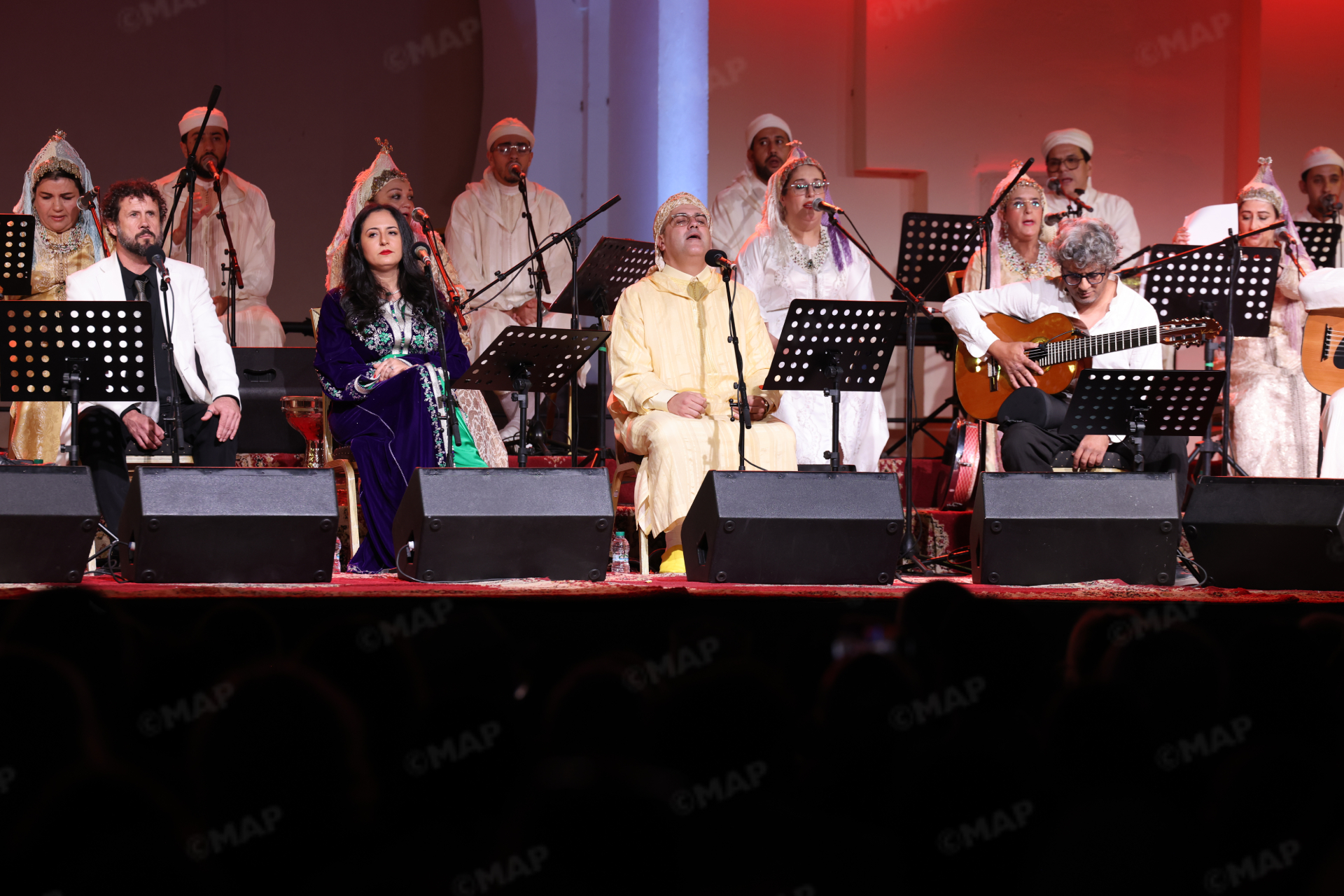
Under the High Patronage of His Majesty King Mohammed VI, the 18th edition of the Fes Festival of Sufi Culture has officially opened. The event aims to transform the city of Fes into a meeting ground for Moroccan spiritual heritage and global wisdom, featuring a program that explores the vital role of poetry and beauty in a world often marked by wounds and hardships.
The festival began with a grand musical ceremony at Bab al-Makina. The opening performance, titled “Paths of Spiritual Love,” featured the Al-Harraqi ensemble performing Arab-Andalusian chants. Led by Youssef El Husseini, the performance included notable contributions from Moroccan artist Nabila Maan and Spanish musician Vincent Moonoz Guillo.
Festival President Faouzi Skali remarked during the opening that this year’s edition is proud to launch with creations from the Zaouia Harraquia, one of Morocco’s great Sufi houses. He noted that their work centers on divine love, spiritual ecstasy, and the delicate, profound meanings of Sufism.
Skali added that the opening ceremony creatively blended the traditional Sufi poetry of the Zaouia Harraquia with the modern artistry of Nabila Maan. This fusion added a distinct aesthetic dimension to the evening, taking the audience on a journey through diverse spiritual meanings and artistic innovations.
Furthermore, Skali emphasized that the festival offers an opportunity to explore the alleys and historical spaces of Fes. As a city with a rich Sufi history, often referred to by practitioners as a “Zaouia” itself, the event allows attendees to delve into the cultural, civilizational, and spiritual secrets inherent in the city’s heart.
Youssef El Husseini, leader of the Al-Harraqi artistic group, explained that the performance merged traditional praise and authentic heritage with Flamenco music. He stated that the goal was not merely to mix musical genres, but to demonstrate that sincere art knows no borders. Music, he suggested, serves as a universal language that celebrates love, coexistence, and freedom among peoples.
The festival’s activities continue Sunday with Shoaib Aftab Qawwal presenting Pakistani Sufi chants inspired by the poet and philosopher Muhammad Iqbal. On October 21, Ustad Wasifuddin Dagar will perform “The Breath of Eternity,” a showcase of the ancient Indian “Dhrupad” chanting tradition from Northern India.
On October 23, the Jnan Sbil Gardens will host spiritual chants from Daouda Konate of Côte d’Ivoire and Enris Quinami of Albania. This will be followed by the artistic work “Journey from East to West,” featuring Marouane Hajji.
The diverse program also includes a collaborative project between Tristan Driessens and the Luthopia ensemble, featuring vocals and harp by Arianna Savall, inspired by the Sufi chants of Hildegard von Bingen. Additionally, the performance “Ibn al-Khatib and the City of Love” will feature Françoise Atlan and Kamal Hafid.
A unique dialogue between artistic and spiritual worlds titled “Bach and Rumi” will take place on October 22, featuring Leïla Anvar and Claire Antonini, highlighting the depth of the inner experience. The festival also includes exhibitions by Odile Guinand and Marie Borcho, alongside a screening of the film “The Builders of the Alhambra” by director Isabel Fernández.
Roundtable discussions will provide intellectual spaces to reflect on various topics, such as “Can Beauty Save the World?”, “Rumi: A Quest for Healing,” “Transformed Affliction in Great Sacred Texts,” and “Poetry and Healing: The Therapeutic Path of Sami-Ali.”
The festival will conclude on the evening of October 24 with a performance titled “Ecstasies.” This finale will bring together Arab-Andalusian Samaa and the Whirling Dervishes of Aleppo, featuring Wasim Arslan, Anas Al-Attar, and Noureddine Tahiri.
Spanning venues from Bab al-Makina to the Jnan Sbil Gardens and the Souq al-Semmarine, the 18th edition seeks to offer Moroccan and international audiences a cultural experience rooted in communication, listening, and a transformative perspective on the world.