

An adviser to the Speaker of the Israeli Parliament since 2019, Orit Moshe maintains a strong attachment to her Moroccan roots. Her relationship with Morocco, her contacts with Moroccan delegations and her role in parliamentary exchanges are highlighted in the account published by Amine Drissi Boutaybi.
At the Israeli Knesset, a Moroccan flag occupies a special place in the office of Orit Moshe, senior adviser to the Speaker of the Parliament, Amir Ohana. Kept in a drawer, the flag has become a symbol of her attachment to Morocco, the country from which her family traces its origins.
Her story was brought to public attention through an article by Amine Drissi Boutaybi, who recounts his encounters with her and describes the personal and institutional connections that have developed around her relationship with Morocco.
Moroccan Roots and a Position at the Knesset
Orit Moshe has worked alongside Amir Ohana since July 2019, when he became Israel’s Minister of Justice. She subsequently continued working with him following his appointment as Speaker of the Knesset.
According to Amine Drissi Boutaybi, Moshe previously advised a member of the Kadima party and a deputy minister from Likud before taking on her responsibilities alongside Ohana.
Her Moroccan origins are an important part of her personal identity. During one of their encounters, she expressed this connection in Moroccan Darija, saying: “جدودنا خلقو فالمغرب” — “Our ancestors were born in Morocco.”
Their first meeting took place in July 2024, shortly before Morocco’s Throne Day celebrations. According to Boutaybi’s account, Moshe warmly welcomed the Moroccan delegation and explained that she intended to travel to Tetouan to attend the national celebrations.
Despite the imminent birth of her daughter, she remained determined to make the journey, a decision that, in Boutaybi’s account, reflected the importance she attached to Morocco.
A Relationship Beyond Official Meetings
Several months later, Orit Moshe contacted Amine Drissi Boutaybi after coming across his publications about Moroccan history, traditions and culture.
She expressed her appreciation for his efforts to share Morocco’s heritage with the public and invited him to visit her at the Knesset whenever he travelled to Israel.
The opportunity came in December 2024, when Boutaybi joined a delegation invited to Haifa for an international conference on regional development.
During his visit, he met Moshe at the Israeli Parliament. According to his account, their conversation lasted more than four hours, despite the numerous professional calls she received throughout the meeting.
Moshe also discussed her involvement in preparing Amir Ohana’s official visit to Morocco in June 2023, an initiative for which she reportedly received formal recognition from the Speaker’s office.
The meeting eventually led to an encounter with Ohana himself, whom Moshe personally introduced to her Moroccan guest.
Amir Ohana and His Moroccan Family Heritage
During the meeting, Amir Ohana spoke about his family background and his parents’ Moroccan origins.
Born in Beersheba on 15 March 1976, Ohana is the son of Meir, who was born in Marrakech and grew up in Rabat, and Esther, whose family comes from Ouezzane.
His parents arrived in Israel during the 1950s and began their lives in transit camps in the southern desert. He also recalled the economic difficulties experienced by his family during those early years.
According to Boutaybi, Ohana spoke about his father’s memories of Morocco, including the exile of King Mohammed V and the songs calling for his return.
He also recalled visiting the Rabbi Shalom Zaoui Synagogue in Rabat in June 2023, where his father had prayed. Referring to the place, he said: “In this synagogue, my father absorbed Zionism.”
The Moroccan Sahara in the Discussions
The question of the Moroccan Sahara was also raised during the conversation between Boutaybi and the Speaker of the Knesset.
Boutaybi explained that, from the perspective of Moroccan public opinion, Israel’s position and actions concerning the Sahara were not sufficiently communicated.
In response, Ohana referred to contacts with Paraguay, explaining that Israel had encouraged the country to support Morocco’s position.
On 11 December 2024, Ohana received Paraguayan President Santiago Peña at the Knesset. Six days later, Paraguay’s Chamber of Deputies adopted a resolution supporting Morocco’s sovereignty over its Sahara and the autonomy plan.
The account also recalls Paraguay’s subsequent recognition of Moroccan sovereignty in September 2025 and its announcement of plans to establish a consulate in the Southern Provinces.
Another important moment concerned Israel’s recognition of Morocco’s sovereignty over the Sahara, announced in July 2023 through a letter addressed by the Israeli Prime Minister to King Mohammed VI.
The Front Page and the Map
Ohana also recalled his official visit to Morocco on 8 June 2023, during which he was received at the House of Representatives by its Speaker, Rachid Talbi Alami.
During that visit, he publicly declared: “The Sahara is Moroccan.”
According to Boutaybi, Ohana showed him a copy of Al Ahdath Al Maghribia, which had published an exclusive article about his visit, alongside coverage in L’Observateur.
He also showed him a map displayed in his office, depicting Morocco as a whole, from Tangier to Lagouira. Ohana had reportedly ordered the map to be changed in July 2023, later describing the decision as a gesture of friendship and respect for Morocco’s unity and sovereignty.
The account contrasts this with a map presented by Benjamin Netanyahu on the French television channel LCI on 30 May 2024, in which Morocco appeared separated from its Sahara. Israel subsequently apologised, describing the issue as a technical error, and corrected the maps.
The Moroccan Flag in Orit Moshe’s Office
One of the most memorable moments described by Boutaybi took place after his meeting with Amir Ohana.
Back in Orit Moshe’s office, he suggested recording a video in which she would address Moroccans in Darija and speak about Israel’s relations with Morocco.
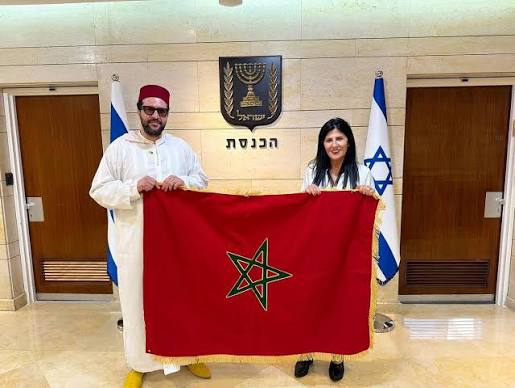
She immediately agreed. She then opened a drawer and took out a large Moroccan flag decorated with golden fringes.
Together, they held the flag beneath the emblem of the Knesset, with Israeli flags visible in the background.
The photograph and video quickly circulated across Moroccan social media. The image of an Israeli parliamentary adviser holding the Moroccan flag inside the Knesset attracted considerable attention, although, as Boutaybi observed, few people knew her name.
Shabbat Shalom, Every Week
The relationship between Orit Moshe and Amine Drissi Boutaybi continued after their meeting.
According to his account, they maintained regular contact, exchanging greetings every week with the expression “Shabbat Shalom” and sending each other messages on Moroccan national holidays.
Boutaybi also describes her attention to Moroccan visitors in Israel. Whenever a Moroccan delegation arrives, she reportedly makes an effort to meet its members.
Her public statements have also reflected her attachment to the Kingdom.
In July 2023, following Israel’s recognition of Moroccan sovereignty over the Sahara, she described the decision as the result of the pioneering role of King Mohammed VI.
Following the United Nations Security Council vote on the Sahara on 31 October 2025, she reportedly expressed deep emotion and pride, declaring: “Morocco is my favourite country in the world.”
In April 2026, addressing Moroccans in a video recorded in Darija, she said: “You are in our hearts, we love you very much.”
Later, in September 2026, in New York, she expressed her feelings towards Morocco with another statement: “For me, Morocco is true love.”
A Personal Connection with Institutional Significance
Orit Moshe’s story highlights a human dimension of relations between Morocco and Israel that extends beyond official diplomatic meetings and political declarations.
Her Moroccan family background, her professional responsibilities alongside the Speaker of the Knesset and her contacts with Moroccan delegations illustrate the importance of personal relationships in maintaining communication between the two countries.
As Amine Drissi Boutaybi explains in his account, her role has involved opening doors for Moroccan visitors and facilitating encounters within the Israeli Parliament.
For him, what distinguishes Orit Moshe is not simply her nostalgia for her family’s country of origin, but the way she continues to express that attachment within the institution where Israeli parliamentary affairs are conducted.
Her story is ultimately represented by a simple but meaningful image: a Moroccan flag kept in a drawer at the Knesset, in the office of a woman who openly embraces her Moroccan roots.