

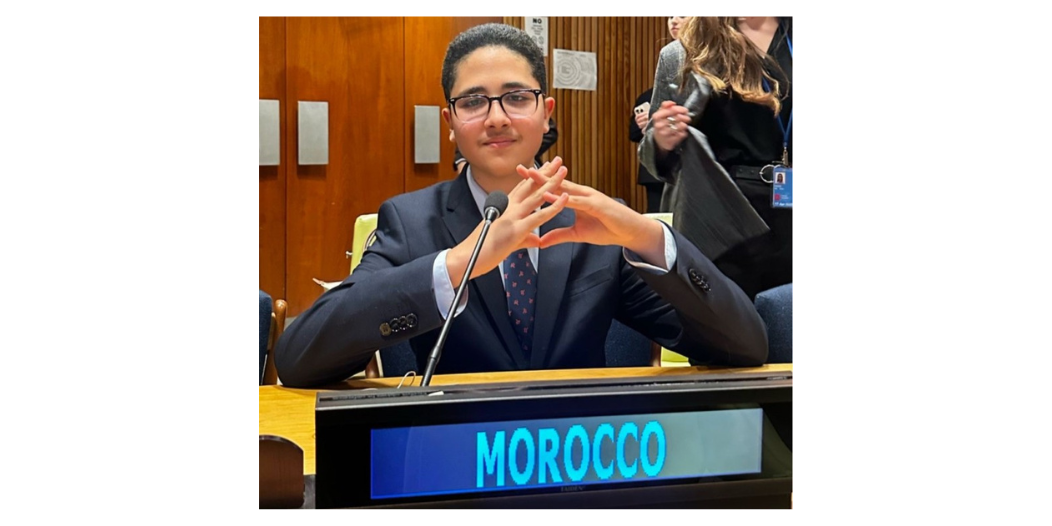
At just 13 years old, Omar Alami is part of a new generation of young Moroccans actively engaged in public life through the Children’s Parliament—an institution unique in the world that offers young people a platform for civic learning and democratic participation. In an exclusive interview, he reflects on his experience, the first African Forum of Children’s Parliaments, and the perspectives he hopes will emerge to strengthen the impact of this initiative in Morocco and beyond.
A School of Citizenship and Responsibility
For Omar, serving in the Moroccan Children’s Parliament is “an incredible and transformative experience.” It has allowed him to discover the realities of democratic debate, the importance of dialogue, and the responsibility of representing the voices of young people.
“We don’t just talk about children’s rights—we practice them,” he explains. During the sessions, young parliamentarians debate concrete social issues, propose solutions, and learn to express their views with respect and empathy. According to him, this experience builds self-confidence while also fostering the ability to listen to others.
One of his most memorable moments was the celebration of the 25th anniversary of the Children’s Parliament, held in Rabat in November 2024 under the presidency of Her Royal Highness Princess Lalla Meryem. A symbolic occasion, he says: “Seeing how the voices of young Moroccans are increasingly heard and respected filled me with pride.”
The African Forum of Children’s Parliaments: A Continental Turning Point
Although he was unable to attend in person, Omar closely followed the first African Forum of Children’s Parliaments, held in Rabat on November 22, 2025, under the High Patronage of His Majesty King Mohammed VI and presided over by HRH Princess Lalla Meryem. For him, the event marked a major milestone.
The Forum brought together delegations from 28 African countries around a clear objective: promoting children’s participation in the development of the continent. “Even from afar, I could feel the energy of these young people and their determination to contribute to a better future,” he says.
The five thematic workshops—inclusive education, mental health, combating child labor, protection against early marriage and life on the streets, and participation in public policies—highlighted both the diversity and relevance of the concerns shared by African youth.
Omar was particularly impressed by the adoption of the Rabat Declaration on Children’s Participation in the Development of Africa and the creation of the African Network for Children’s Rights, hosted by the National Observatory for Children’s Rights.
“This shows that children’s participation now goes beyond borders. It has become a continental movement,” he affirms.
Including Moroccan Children Around the World: Omar’s Key Proposal
Drawing on these experiences, Omar—President of the Youth Committee of the Federation of Moroccan Skills Residing Abroad in Washington—advocates for a broader opening of the Moroccan Children’s Parliament. His proposal is clear: to include Moroccan children living abroad.
“Many of them remain deeply attached to their country. Giving them a place would strengthen the Parliament and allow us to benefit from their perspectives and experiences,” he believes. A dedicated section or network for young Moroccans in the diaspora could, in his view, create a bridge between children in Morocco and those around the world.
He already envisions joint initiatives: cultural exchanges, digital projects, awareness campaigns—programs that would help spread Moroccan values of solidarity, creativity, and peace.
“Just as Africa needs a united youth, Morocco must connect its young people wherever they live. We all share the same dream: to make our country shine,” he concludes.
A Young Spokesperson for an Engaged Generation
Through his commitment, Omar embodies a conscious, responsible Moroccan youth determined to contribute to sustainable development at the national, continental, and international levels. His perspective on educational, social, and democratic challenges reflects a rare maturity for his age.
In a Morocco that increasingly invests in education and youth civic participation in line with Royal directives, voices like his demonstrate that the country’s future is in good hands.