

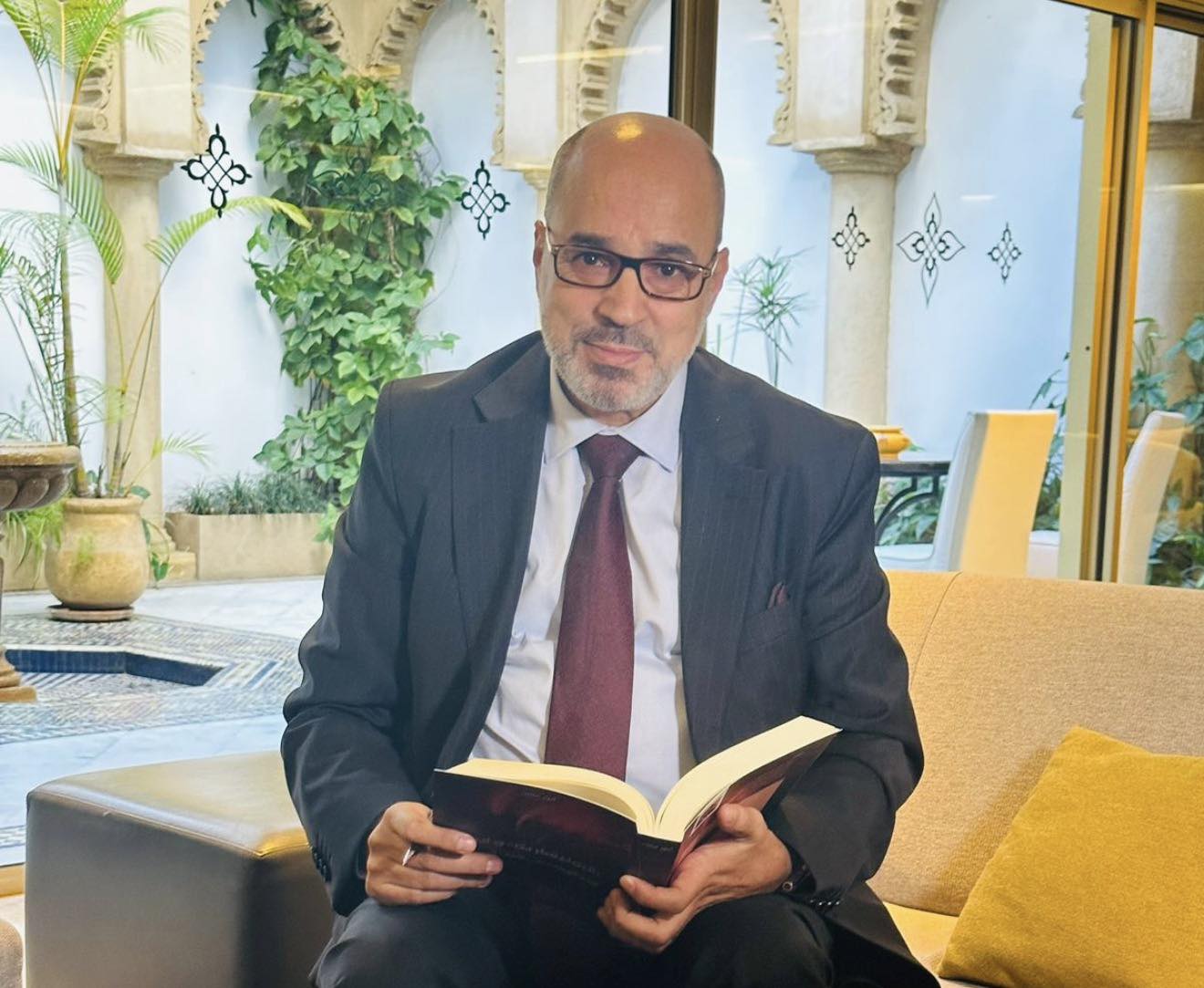
Algerian writer and dissident journalist Anwar Malek opens one of the most sensitive files in North Africa and the Sahel region, relying on rare documents he obtained during his work as an international observer in Syria, published today for the first time.
This work is not limited to presenting an analytical narrative of the hidden relationship between the Polisario Front and the Iranian regime; it goes further by revealing complex entanglements linking Tehran to networks of weapons and financing operating in the region under the cover of Algerian roles that Malek describes as going beyond the traditional limits of political support.
The book places this relationship in a broader regional context, where Iranian interests intersect with the dynamics of the conflict in the Sahara, and with the calculations of the Algerian regime, which Malek considers to be managing its internal and external crises more with obstinacy than with strategy.
The author reveals threads of influence extending from the Tindouf camps to the decision-making circles in Tehran, framing them with data he describes as “astonishing” to the public, given their direct implication in arms trafficking and in the repurposing of non-state actors in geopolitical equations that exceed the Maghreb.
Between analysing the dimensions of this Iranian support and its impact on the course of the conflict, and assessing the future of the Algerian regime under the pressure of accumulated crises, Anwar Malek offers a critical reading of the choices of power in Algeria, considering that their consequences already affect the stability of the entire Maghreb. He also raises in his book — through the lens of an opponent — a central question about Algeria’s ability to revise its approach to the Sahara issue or continue down what he sees as a dead-end path that undermines the interests of the region.
In the exclusive interview with Al-Sahifa newspaper, he sheds light on additional aspects behind this work, the circumstances of its initiation, and the documents that formed its core. There, Anwar Malek sets out his full account of the motives that led him to this topic, the research paths that opened unexpected threads, and offers a deep analysis of the intersections of the Iranian project with the Polisario Front, the limits of the Algerian role in one of the most complex regional conflict files—intertwining politics, security, and intelligence—along with the internal situation in Algeria and its current diplomatic posture.
What motivated you to focus on the relationship between the Polisario and Iran in this book? Was there an event or document that served as the starting point?
Anwar Malek says he considers himself among the most specialised in the Iranian file and Iran’s regional relations, recalling that in 2010 he published a book on the secrets of Shiism and terrorism, and worked on this issue for years, both through his writings and through his presence in an international observer mission in Syria, which allowed him to follow the evolution of the Syrian situation at various international levels.
He adds: “In my view, the main starting point was my interest in the expansions of the Iranian project in the region. I am the first Algerian, at the Maghreb level and perhaps internationally, to have addressed this topic so early.”
Malek explains that his work on Shiite expansion in Algeria allowed him to detect initial signs of Iran’s attempts to create a military arm in the country, beginning with the Armed Islamic Group “GIA”, then with what he later wrote about the “Maghreb Hezbollah” project, before threads of the relationship with the Polisario Front became clear.
The Algerian author confirms that what pushed him to dig deeper were leaked Syrian intelligence documents containing data indicating the participation of Polisario elements in combat alongside Iranian militias in Syria, as well as information revealing the transformation of the separatist Front into an operational extension of the Iranian project in the region — which he considered a direct threat to Maghreb and regional national security — and decided to produce an independent book on the subject.
How do Iranian interests intersect with the parties involved in the Sahara conflict?
He answers: “The first thing to understand is that the Iranian regime naturally seeks to infiltrate conflict hotspots and control the threads of crises. This has been the approach of the mullahs for years, in the Levant and in our Maghreb environment as well.”
He adds that Iran appears in all areas of chaos: in the Sahel and Sahara, in Libya and Egypt, and even in Algeria during the 1990s through its Hezbollah arm, after facilitating the rise of a Shiite loyal to Wilayat al-Faqih to the leadership of the GIA, named Mahfoud Tajine.
Malek continues: “In my view, Iran has long sought a foothold in deep North Africa, which is why we see it present with rebel or radical groups, even those ideologically different from it — from Boko Haram to Al-Qaeda and Daesh, and even Hamas. This is its method: infiltrating armed movements and exploiting them politically and militarily.”
He considers the Maghreb region to be of strategic concern to Iran due to its location south of the Mediterranean. Tehran’s successive losses in the Levant have pushed it to rely on the African continent to compensate for its influence. In this context, he recalls that Khomeini recognised the so-called “Sahrawi Republic” in the early 1980s, and today the Iranian regime sees in the separatist Front a suitable vehicle for penetration — in parallel with the interests of the Algerian regime — with no strategic links with Tunisia or Mauritania, and facing Morocco’s vigilance and its protection of spiritual and ideological security.
What were the most notable surprises or new information discovered during the preparation of the book?
The book contains unprecedented data, including documents on the Polisario’s relationship with Syrian intelligence and others relating to direct coordination with Hezbollah.
Among the most important discoveries is a meeting record between Polisario leader Brahim Ghali and Syrian intelligence, and for the first time it is revealed that Front elements participated in the 2012 battle of Al-Qusayr alongside Hezbollah against Syrian rebels, with casualties.
Other surprises include that “Yasslam Bissat”, the current Polisario minister of foreign affairs, received a bribe, a phone, and a specific sum of money in an official document from the then Syrian ambassador. There is also information about sensitive meetings involving the wife of the late president Houari Boumediène, and meetings with generals and political leaders on issues such as the assassination of Boudiaf.
After the book was sent to print, Malek discovered that Polisario members killed in Al-Qusayr were presented by the Front as victims of clashes with the Moroccan army.
Do you believe Algerian support for the Polisario is based on strategic or ideological grounds?
“At first I thought it was based on strategic and ideological foundations,” he explains. “But during my research I found data to the contrary.”
He met generals and high-ranking Algerian officials but was surprised to find that many had no real strategic explanation for this support, which cost the treasury more than 500 billion dollars.
Malek adds that the wife of the late Houari Boumediène told him that only her husband knew the true purpose of creating the separatist Front, describing it simply as a “stone in the shoe” of the late King Hassan II, and that the matter was mainly related to border demarcation.
According to her, the plan was ideological at first, linked to the leftist and liberation currents of the time, but after Boumediène, the military regime inherited the issue and used it only as a tool of confrontation with Morocco.
He cites a general’s answer when asked if Algeria’s goal was access to the Atlantic: “I don’t know.”
And when asked if there were prior agreements with the Front in case of separation: “Never.”
He concludes that the regime seeks only to settle scores with Morocco.
How do you assess the way the Algerian regime has managed internal and external crises in recent years?
“In my opinion, the Algerian regime today is experiencing an unprecedented collapse. Internally, it is incapable of managing the crises it created and aggravated — as most Algerians recognise. Externally, it has lost the ability to formulate a diplomatic strategy or a clear vision of national interests.”
He adds that the era of Abdelmadjid Tebboune is the worst in Algeria’s history in terms of internal and external crisis management.
The absence of development programs or plans to resolve crises or manage balanced relations with neighbours has placed the people in internal and external isolation without precedent.
How do you see the future of the Algerian regime given internal and external pressures?
Malek believes the regime lives in fear of the future due to increasing popular pressure and intensifying conflicts within its own wings. This has manifested in the imprisonment of political figures and leaders who were decision-makers; he describes this phase as one of “raw force”.
He adds that the regime is besieged by crises with Morocco, Mali, Libya, France, Spain, and the UAE, and that UN resolution 2797 was a major blow, especially with the possibility of the Polisario being classified as a terrorist organisation. According to him, the Tebboune era has ended, and the regime is now looking for an “ending” to the scenario that began in 2019 with the toppling of the Hirak.
How do you assess the impact of Iranian support on the Sahara issue? Could it have repercussions in the Maghreb?
“Iranian presence wherever it exists produces chaos. In my view, Iranian expansion in Algeria has reached an extremely dangerous level and will have negative repercussions on the internal situation.
The collapse of Algeria’s internal stability will have direct effects on the Maghreb.”
He considers that Iranian support for the Polisario will harm Algeria more than Morocco, because the Sahara issue, in his view, is already settled—especially after the shift of October 31.
If you could send one message to the Algerian regime about the Sahara, what would it be?
Anwar Malek addresses Algerian decision-makers: “If you care about the interest of Algeria and the region, accept Morocco’s extended hand. The solution lies in addressing the file within the Maghreb and family framework, according to the autonomy proposal — with no alternative.”
He adds: “Persisting in obstinacy will lead to challenges the Algerian people will pay for, and the situation may reach the phase of ‘oil for food’. If you do not wake up now, while you still have room, vigilance will not help you when international pressure increases.”
He concludes by affirming that the opportunity is still open, and insisting on keeping the conflict benefits neither the Algerian people nor the reputation of the Algerian state.